
Untranslatable Greek words
1221 words • 5 min to read
I just spent 2 hours correcting a list of supposedly untranslatable Greek words on eunoia.world.
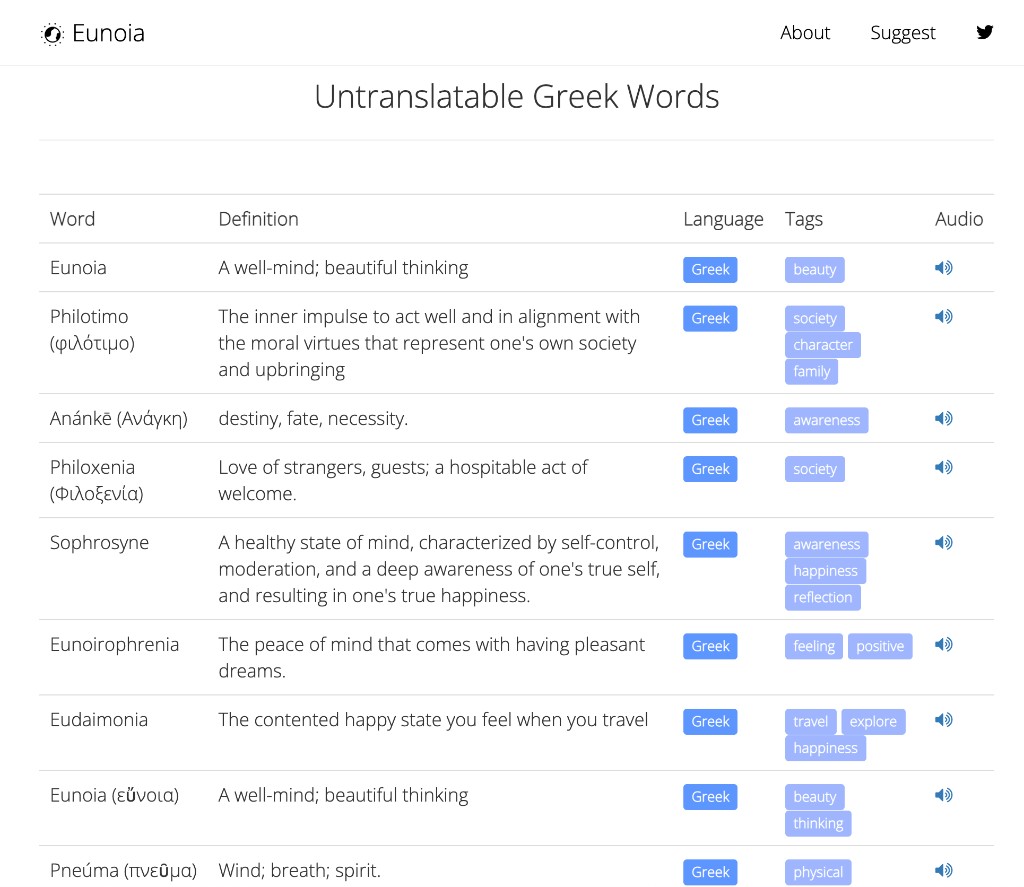
Many were in fact easily translatable, some had wrong definitions, a few were duplicates, one was Latin, and some were recently coined Greek-sounding words! I emailed the site’s owner and it’d be cool if they updated it, but this seems like an old side project, so we’ll see.
In any case, I didn’t want to feel like I might have completely wasted my effort, so here I am sharing the words, with the correct definitions, and my favorite wrong ones.
Context
Eunoia.world is an online directory of “untranslatable words”, AKA words without a direct, single-word translation in most other languages.
Anyone can “suggest” a word for the site’s owner to add to the list.

What I found fascinating is that, apparently, some people suggested common Greek words, but with highly romanticized, fancy definitions that are simply untrue.
The romanticized ordinary words
Volta
- Greek: βόλτα
- Real meaning: walk, stroll. As in, “I’m going for a walk”.
- Eunoia “definition”: “During certain hours of the early evening, around dusk, everyone in the town who might feel like going for a walk takes a saunter or stroll up and down the main street”.
Just… what? That’s not a definition! It’s a description of a behavior. Someone tried to make this standard Greek word (of Italian origin, actually) sound like a profound tradition, when it’s just a word. Some people just like to go for walks, some around dusk. It’s not deep.
Parea
- Greek: παρέα
- Real meaning: friend group, clique.
- Eunoia “definition”: “A group of friends who regularly gather together to share their experiences about life, their philosophies, values and ideas.”
All of that additional stuff is completely invented out of thin air. Again, someone was trying too hard to make a standard Greek word sound much deeper than it is.
Andria
- Greek: ανδρεία
- Real meaning: courage.
- Eunoia “definition”: “Both valour and courage, expressed in actions in front of the face of danger”.
Whoever wrote this was trying too hard. Incidentally, this word’s root is the Greek word for “man”. So it literally means something like “the essence of masculinity”…
Eunoia
- Real meaning: favor, goodwill.
- Website “definition”: A well-mind; beautiful thinking.
Ironically, despite being the domain name of the site, Eunoia itself is translatable. It means “favor”, as in “he invited the one he favors”. It’s used in figures of speech like “to be favored by luck” (έχει την εύνοια της τύχης).
It does literally mean “good mind” (ευ + νους), but that’s not what it actually means. Not even in ancient Greek. “Good mind” (or “good thinking”) was meant metaphorically, as in “my thoughts towards you are good” → you have my goodwill, my favor.
The made-up ones
Anemoia
- Eunoia “definition”: “Nostalgia for a time that you have never lived”.
I was confused because I first read this as “Anemia” (lack of hemoglobin). But it’s actually not a Greek word at all. It was coined in 2012 by John Koenig for his project The Dictionary of Obscure Sorrows. In other words, not a real word.
Euneirophrenia
- Eunoia “definition”: “The peace of mind that comes with having pleasant dreams.”
- It was also misspelled as “Eunoirophrenia”
This isn’t a real Greek word. It looks like a blend of ευ (“good”) + όνειρο (“dream”) + φρήν (“mind”). Someone must have “coined” it recently, although I can’t find out who. Listicle writers (as usual) didn’t do their research and started presenting it as a real Greek word.
But if you search for this word on Google in Greek (“ευνειροφρένια”), there are literally 0 results — what a rare sight! It’s only in English that you get results. So much for being an untranslatable “Greek” word ;)
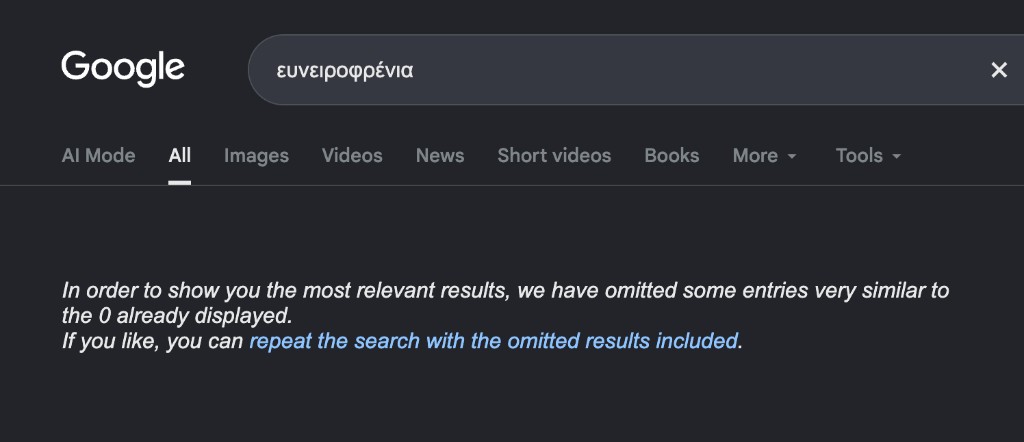
I suppose after this post gets indexed, there’ll be a single result. 🤔
The love types
In the 20th century, writers like C.S. Lewis and John Alan Lee borrowed Greek and Latin words as the names for love styles they came up with. Years later, online listicles started presenting them as ancient Greek concepts, but they’re not.
Understandably, some people came to believe that the meaning of those Greek and Latin words = the love type the writers described. I don’t mind the oversight because it introduced me to John Alan Lee, who has done quite a few interesting things in his life.
Agape
- Greek: αγάπη
- Real meaning: love.
- Eunoia “definition”: selfless love to all, universal loving kindness
Nope, it’s just “plain” love. A great concept indeed, but decidedly not untranslatable.
Philia
- Greek: φιλία
- Real meaning: friendship.
- Eunoia “definition”: “‘highest form of love’; deep love between friends, brotherly love”.
This one is also just “friendship”. There’s no other word for “plain” friendship, as opposed to this supposed “deep love between friends”.
Pragma
- Greek: πράγμα
- Real meaning: thing, object.
- Eunoia “definition”: “longtime love, such as in long marriages”.
Pragma was John Lee’s nickname for “pragmatic love”.
Ludus
John Lee’s “playful love”. This one isn’t even Greek. It’s Latin.
The actually untranslatable ones
After this exercise, I was left with a list of actually untranslatable Greek words, which I present to you below.
- Akrasia
- Greek: ακρασία
- Acting against your own better judgment; lack of self-control. Literally “lack of power (over yourself)” (α- “not” + κράτος “strength, power”). Inability to “hold” oneself back (κρατάω = hold). Note: I’d never encountered this word.
- Charmolypi
- Greek: χαρμολύπη
- Joy mixed with sorrow; bittersweet. Literally “joy-sorrow” (χάρμα “joy” + λύπη “sorrow”). Note: I’ve never encountered this word. It’s apparently rare and literary.
- Evdaimonia
- Greek: ευδαιμονία
- Intense happiness; a state of flourishing and good fortune. Literally in “good spirits” (ευ “good” + δαίμων “spirit”).
- Filotimo
- Greek: φιλότιμο
- The inner impulse to act well and in line with the moral virtues of your society and upbringing. Literally “love of honor” (φίλος “dear, loving” + τιμή “honor”).
- Meraki
- Greek: μεράκι
- Doing something with soul, creativity or love; putting something of yourself into it. From Turkish merak (“curiosity, keen interest”).
- Nipenthes
- Greek: νηπενθές
- In the Odyssey, a fictional drug that makes you forget grief. Literally “no grief” (νη- “not” + πένθος “grief”). Note: had to look this one up. Not sure it qualifies as a real word, since it’s the name of a fictional drug.
- Polytropos
- Greek: πολύτροπος
- “Of many ways”: versatile, cunning, much-wandering. Homer’s epithet for Odysseus in the first line of the Odyssey. Πολύς “many, much” + τρόπος “way”.
- Ripsaspis
- Greek: ρίψασπις
- One who throws away his shield in battle; a coward or deserter. Literally “shield-thrower” (ρίπτω “throw” + ασπίς “shield”).
- Sofrosyni
- Greek: σωφροσύνη
- Self-control, moderation and sound judgment. Literally “sound mind” (σώος “sound” + φρήν “mind”).